
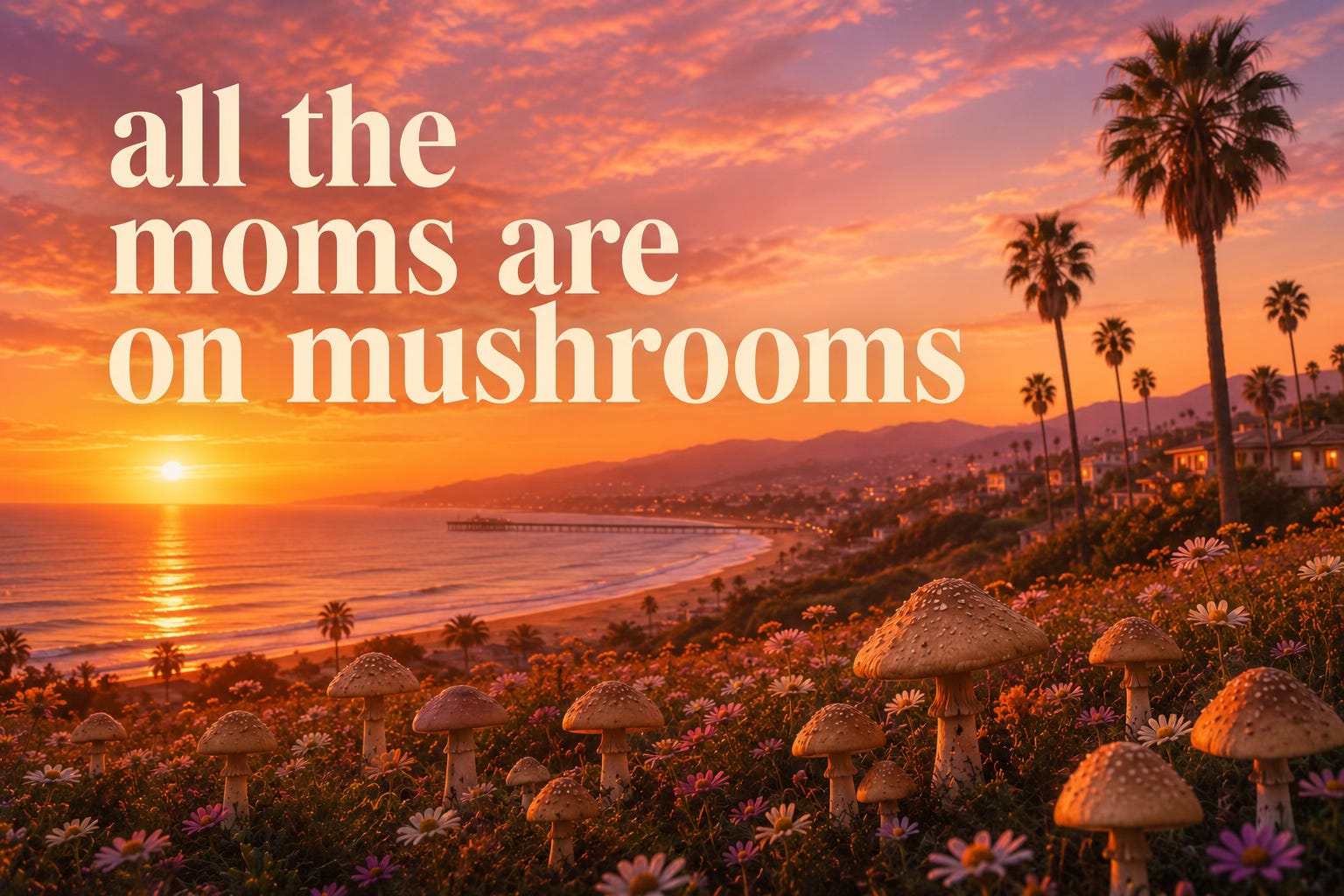
Something has shifted on the Westside. If you’ve been to a school pickup recently, or a birthday party, or honestly just a parking lot, you’ve noticed it. The moms are different. Not different in a bad way. Different in a way that is warm and slightly unnerving and makes you feel like you’re the only person in the room who didn’t get a memo.
They are, for lack of a more clinical term, soft AF. Not soft like they’ve given up. Soft like they’ve relaxed. They make extended eye contact. They mean it when they ask how you’re doing. They cry tears of joy when they see Gaviota strawberries are only twenty bucks for three containers. These aren’t women overwhelmed by the chaos of living in a place like LA. No. These are women connected.
This is not the Westside of three years ago, when the dominant emotional register was a specific kind of controlled panic dressed up as thriving. When “we’re just going with the flow” was said with the expression of a person who had not slept since the first Trump administration. When every conversation about your child eventually became a competition no one admitted was happening.
Something changed. And if you follow the evidence, it leads, fairly directly, to the farmer’s market.
How It Actually Works
Here is what happens, and what no one explains to you when you move to the Westside: there is a tiered system. At the base is the functional stuff — the capsules, the tinctures, the $22 lattes at the wellness café on Montana where everything on the menu is described as “nervous system support.” This layer is legal, visible, openly discussed at the playground. This is not the layer we are talking about.
The layer we are talking about operates on referral. You get in through someone who is already in, who vouches for you, who decides — based on criteria that are never stated explicitly — that you’re ready. People describe these experiences as journeys, which is a word that can mean many things and in this context means many things. How people find their way to a journey is considered a private matter. There’s a therapist in Brentwood who has opinions. There are retreats in Topanga. There is, you know, the farmer’s market.
The journeys themselves happen on weekends when the kids are at their dad’s. Carefully arranged setting. Eye mask. A playlist assembled with the gravity someone might bring to a state funeral. At least one throw blanket from the boutique in Venice that doesn’t list prices. A guide who is either trained or a trusted friend or a trusted friend who has done enough of these that the distinction has become somewhat academic.
By Sunday evening, someone in the group chat sends a message that says, simply: I love you all so much. Everyone knows. No one says anything. Heart emoji. Heart emoji. Heart emoji. The thread moves on to scheduling carpool.
The Before Times
To understand why this is happening, it helps to remember what Westside mom culture looked like five years ago. The dominant activity was optimization. Optimizing the child: sleep schedules, enrichment, the preschool pipeline, the narrative you were building for the admissions consultant who cost $400 an hour and who assured you the process was about fit and not also about money, which everyone understood to be a thing you say. Optimizing yourself: Pilates, infrared sauna, the cold plunge, the elimination diet, the functional medicine doctor who didn’t take insurance but had a four-month waitlist, which was itself a form of social proof on the Westside.
The performance of having it together, maintained at considerable cost, while not having it together at all.
“I was tracking everything,” one Brentwood mother told us, with the specific tone of someone describing a previous relationship they’re mostly over. “My sleep. My HRV. My son’s sleep. His bowel movements, honestly. I had a spreadsheet.” She paused. “I don’t have the spreadsheet anymore.”
What she has instead, she says, is a different relationship to control. Which is something people say. But she also seems, genuinely, less difficult to be around at pickup. So there’s that.
What It Looks Like From the Outside
The clearest sign that something has changed is the quality of the conversations. There used to be a specific kind of Westside small talk that was essentially a status exchange conducted in the grammar of wellness. We’ve been doing a lot of beach time. He’s really thriving at his new school. We just got back from a digital detox in Costa Rica, it was incredibly restorative. The information content was low. The subtext was dense. You came away knowing less about the person than when you started.
That register still exists. But alongside it, increasingly, there are actual conversations. About hard things. The specific texture of finding parenthood both beautiful and relentless. Marriages that are fine and also kind of aren’t. The gap between the life you built on paper and what you actually feel inside it. Things that people were not saying at drop-off three years ago. And I, for one, really appreciate that.
The Children Are, For the Record, Fine
The kids seem okay. Better than okay, in some cases. There is a six-year-old in Pacific Palisades — his name is actually Cosmo — who has absorbed enough of the ambient therapeutic vocabulary that he now actively coaches adults through emotional moments. His mother was crying at the market recently, not from distress but from the kind of generalized awe that has become common in this community, and Cosmo patted her hand and said, with complete sincerity: “Let it move through you, Mama.”
He is six. He has, to his parents’ knowledge, never been to therapy. He has simply been around a lot of people doing the work, and some of it has stuck. Whether this is wonderful or mildly concerning is a question we leave to the reader’s own nervous system.
Is This, On Balance, Good?
The honest answer is probably yes.
The mothers of the Westside were not doing great. That’s the part that gets lost in all of it — the oat milk and the ceremonial cacao and the playlist assembled like a state funeral. Underneath the performance, there were a lot of women managing a genuinely difficult situation: high-pressure parenting culture, expensive real estate, ambitious careers, a wellness industry that monetized their anxiety and called it self-care. That combination was making real people miserable in ways they were not permitted to say out loud.
If whatever is happening in this community — the retreats, the circles, the journeys, the farmer’s market runs that take two hours longer than they used to — is giving people access to themselves they didn’t have before, it’s hard to argue with the outcome. The research on various wellness modalities is increasingly legible. The stigma around emotional openness is decreasing. The conversations now happening in this community, even in code, are conversations that weren’t happening before.
The caveats are predictable. Access tracks money and social capital, as everything on the Westside does. The integration work varies wildly, and “my friend held space for me” is not a clinical standard. And there is always the possibility that a culture which turned self-improvement into a competitive sport will simply do the same thing here, and whatever is in those paper bags will become another item on the wellness checklist, stripped of meaning, available at Erewhon next spring in a $48 tincture that does nothing.
But that hasn’t happened yet. Right now, the moms seem — if not healed exactly, then at least a little less at war with themselves. They are having conversations they weren’t having before. They are crying at the farmer’s market for reasons that, on reflection, are not that strange. Some of those reasons are available at the farmer’s market.
We will leave it there.